








Learning a new language can be exciting, especially when you discover unusual words with interesting meanings. Spanish is one of the most widely spoken languages in the world, and it contains many beautiful and unique words. Some letters are very common in Spanish vocabulary, while others are less frequently used.
One interesting letter is the letter “Y.” Even though not many Spanish words begin with this letter, the ones that do often have fascinating meanings, cultural importance, or historical backgrounds.
In this article, we will explore several Spanish words that start with Y, learn what they mean, and understand why they are interesting. This guide is written in simple language so students and beginners can easily understand and enjoy learning.
Why the Letter Y Is Unique in Spanish
In Spanish, the letter “Y” is special because it works both as a letter and as a word.
For example:
- The word “y” means “and” in English.
- It is also used in many names, expressions, and borrowed words.
Compared to letters like “C” or “S,” there are fewer Spanish words beginning with “Y.” However, the words that do exist are often memorable and culturally meaningful.
Common Spanish Words That Start With Y
Here are some interesting Spanish words beginning with the letter Y and their meanings.
| Spanish Word | English Meaning | Interesting Fact |
|---|---|---|
| Yate | Yacht | Refers to luxury boats and travel |
| Yerno | Son-in-law | Common family relationship term |
| Yema | Egg yolk | Also used for plant buds |
| Yegua | Female horse | Important in farming culture |
| Yacimiento | Deposit or archaeological site | Used in history and science |
| Yuca | Cassava | Popular food in Latin America |
| Yogur | Yogurt | Borrowed from another language |
| Yodo | Iodine | Used in science and medicine |
These examples show that even though the list is shorter, many Spanish words that start with Y have useful and interesting meanings.
Yate: A Word Connected to Luxury
The Spanish word “yate” means “yacht” in English.
This word is often connected to:
- Luxury travel
- Wealth
- Ocean adventures
- Tourism
In Spanish-speaking countries near coastal areas, yachts are associated with vacations and expensive lifestyles.
Example sentence:
- El hombre tiene un yate grande.
(The man has a large yacht.)
This word sounds modern and elegant, which makes it easy for learners to remember.
Yerno: A Family Relationship Word
The word “yerno” means “son-in-law.”
Family vocabulary is very important in Spanish culture because family relationships are highly valued in many Spanish-speaking countries.
Example sentence:
- Mi yerno trabaja como médico.
(My son-in-law works as a doctor.)
Even though it is a simple family word, it reflects the importance of close family connections in Hispanic culture.
Yema: More Than Just an Egg Yolk
The word “yema” usually means “egg yolk,” but it can also describe plant buds or soft growing parts of plants.
This makes the word interesting because it has multiple meanings depending on the situation.
Example sentence:
- La yema del huevo es amarilla.
(The egg yolk is yellow.)
In gardening and biology, “yema” may refer to new plant growth.
Spanish Learning and Vocabulary
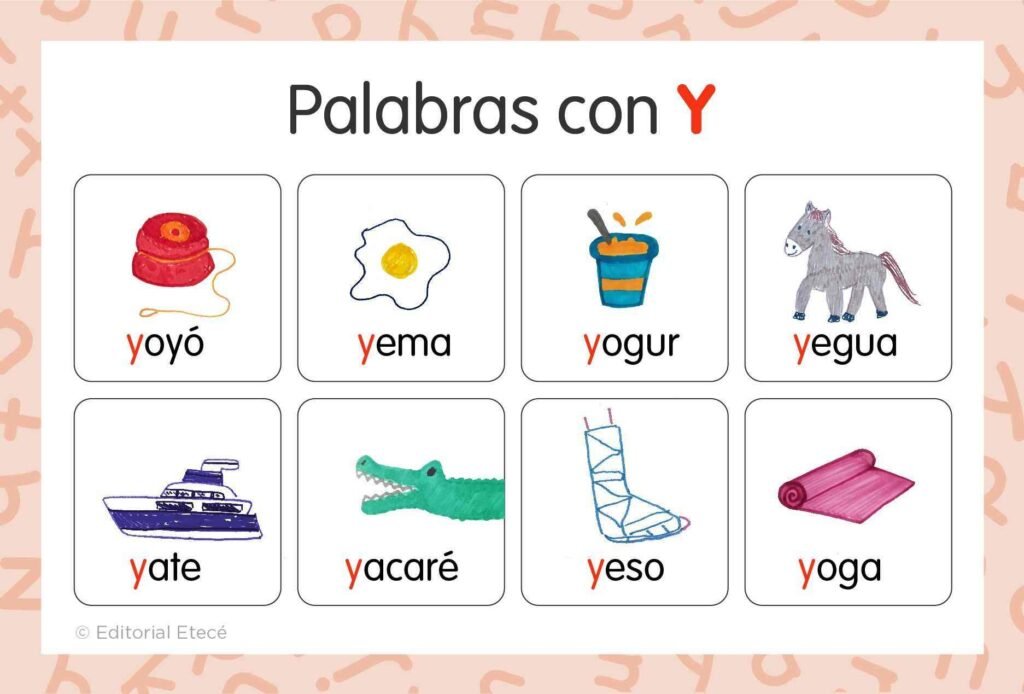
Yegua: A Word From Rural Life
The Spanish word “yegua” means “female horse” or “mare.”
Horses have played important roles in farming, transportation, and culture throughout Spanish-speaking history.
Example sentence:
- La yegua corre muy rápido.
(The mare runs very fast.)
In some regions, the word may also appear in stories, songs, and rural traditions.
Yacimiento: A Word Used in Science and History
One of the most interesting Y words is “yacimiento.”
This word can mean:
- A mineral deposit
- An oil field
- An archaeological site
It is widely used in history, geology, and science.
Example sentence:
- Descubrieron un yacimiento arqueológico antiguo.
(They discovered an ancient archaeological site.)
This word shows how Spanish vocabulary connects with education and scientific discovery.
Yuca: A Popular Food in Latin America
The word “yuca” refers to cassava, a root vegetable commonly eaten in Latin American countries.
Yuca is used in many traditional foods and recipes.
It can be:
- Fried
- Boiled
- Mashed
- Used in soups
Example sentence:
- La yuca frita es deliciosa.
(Fried cassava is delicious.)
Learning food vocabulary helps students understand culture as well as language.
Yogur: A Borrowed Word
The word “yogur” means yogurt.
Interestingly, this word originally came from another language and became part of Spanish vocabulary over time.
This demonstrates how languages often borrow words from each other.
Example sentence:
- Desayuno yogur con frutas.
(I eat yogurt with fruit for breakfast.)
Borrowed words are common in modern languages because cultures interact globally.
Yodo: A Scientific Term
The word “yodo” means iodine.
It is commonly used in:
- Science classes
- Medicine
- Nutrition
- Health discussions
Example sentence:
- El yodo ayuda al cuerpo humano.
(Iodine helps the human body.)
Scientific vocabulary helps language learners understand academic topics more easily.
Why Learning Rare Words Is Helpful
Some students may wonder why learning uncommon vocabulary matters.
Rare words can help learners:
- Expand vocabulary
- Improve reading skills
- Understand culture
- Recognize scientific terms
- Speak more naturally
Even though there are fewer Spanish words that start with Y, learning them improves overall language knowledge.
The Cultural Importance of Language
Language is not only about communication. It also reflects:
- History
- Traditions
- Food
- Science
- Family life
- Social values
For example:
- “Yuca” reflects Latin American cuisine.
- “Yerno” reflects family relationships.
- “Yacimiento” reflects scientific and historical discovery.
Each word tells something about the people and cultures that use it.
Tips for Remembering Spanish Vocabulary
Learning vocabulary becomes easier with practice and repetition.
Here are some helpful tips:
Use Flashcards
Write the Spanish word on one side and the English meaning on the other.
Practice Daily
Even 10 minutes of daily practice can improve memory.
Use Words in Sentences
Creating sentences helps learners remember meanings better.
Watch Spanish Videos
Movies and educational videos help students hear words naturally.
Label Household Items
Putting labels on objects can improve vocabulary quickly.
Why Spanish Is Popular Worldwide
Spanish is one of the most spoken languages in the world.
Millions of people speak Spanish in:
- Spain
- Mexico
- Argentina
- Colombia
- Peru
- Chile
- The United States
Because of its global importance, many students choose to study Spanish for school, travel, or career opportunities.
Learning unique vocabulary words makes the process more fun and interesting.
Interesting Facts About the Letter Y
The letter “Y” has some unique features in Spanish:
- It is sometimes called “i griega” in Spanish.
- It can act as both a consonant and a vowel sound.
- It also works as the word “and.”
This makes the letter more versatile than many other letters in the alphabet.
Language Learning Builds Confidence
Studying languages helps students improve:
- Memory
- Communication skills
- Cultural understanding
- Confidence
- Problem-solving abilities
Learning even small groups of words can help students feel motivated and successful.
Exploring Spanish words that start with Y can make vocabulary learning more creative and enjoyable.
Conclusion
Even though there are not many Spanish words beginning with the letter Y, the words that do exist have interesting meanings connected to culture, family, science, travel, and food.
Words like “yate,” “yuca,” “yerno,” and “yacimiento” show how language reflects real-life experiences and traditions. Learning uncommon vocabulary helps students expand their knowledge and better understand Spanish-speaking cultures.
Studying Spanish words that start with Y may seem like a small topic, but it offers a fun and educational way to improve language skills while discovering fascinating meanings behind everyday words.
FAQs:
What does the Spanish word “y” mean?
The word “y” means “and” in English.
Are there many Spanish words that start with Y?
No, there are fewer Y words compared to other letters in Spanish.
What does “yuca” mean in Spanish?
“Yuca” refers to cassava, a popular root vegetable in Latin America.
Why is the letter Y special in Spanish?
It works both as a letter and as the word “and.”
What is the meaning of “yacimiento”?
It means a deposit, oil field, or archaeological site depending on the context.


I blog often and I genuinely thank you for your content. This article has really peaked my interest.
I will book mark your blog and keep checking for new information about once a week.
I subscribed to your RSS feed as well.
Hey, I searched for this blog on Bing and just wanted
to say thanks for the excellent read. I would have to agree with
it, thank you again!
I’ve read some excellent stuff here. Certainly worth bookmarking for
revisiting. I surprise how much effort you put to create
one of these magnificent informative site.